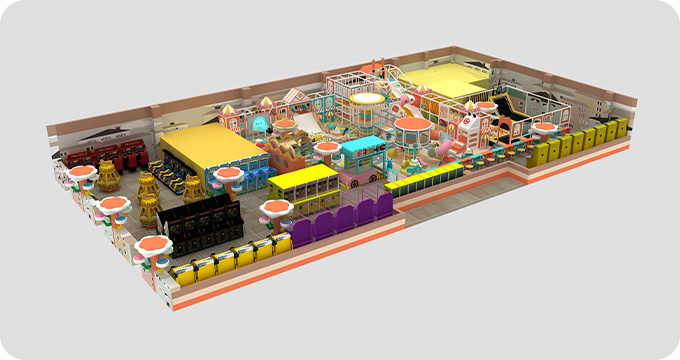
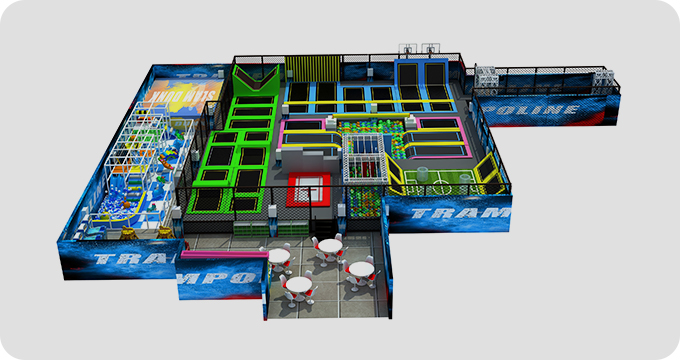
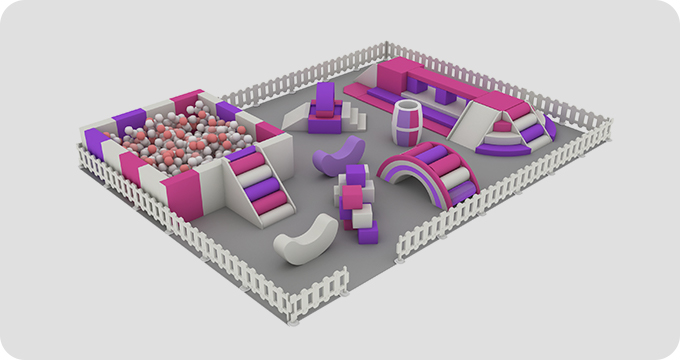
Designing a commercial trampoline venue is fundamentally different from arranging playground equipment on a flat floor. The height of the ceiling, the placement of each jump area, and the separation between high‑impact zones and quiet zones all interact to determine how many visitors the park can safely accommodate and how efficiently staff can supervise the space. A layout that ignores these relationships may pass an initial inspection but will create bottlenecks during peak hours, shorten the life of the equipment, and increase the risk of user collisions.
This guide walks through the key design considerations for a trampoline entertainment facility, covering space requirements, zone planning, attraction selection, and the flow of visitors and staff.
1. Space Requirements: Ceiling Height and Floor Area
The single most important dimensional constraint for a trampoline park is the clear ceiling height. A minimum of 5.0 metres (approximately 16.4 feet) is required for most standard jumping areas; competitive or performance trampolines may demand 6 metres or more to accommodate the height an experienced jumper can reach. Any obstruction – beams, ductwork, lighting fixtures – must be above this clearance zone, and protective padding should cover any unavoidable low‑hanging elements.
The total floor area determines the mix of attractions. A compact park of around 500 square metres can house a free‑jump zone, a foam pit, a dodgeball court, and a small kids' area, while a full‑scale venue of 1,000 square metres or more can add dedicated ninja courses, climbing walls, slacklines, and dedicated party rooms. The usable area calculation should subtract space for the reception desk, lockers, seating, and corridors.
When planning the floor layout, the structural load of the trampoline frames and the dynamic forces generated by multiple jumpers must be confirmed with the building engineer. Most trampoline equipment is anchored to the floor, and the existing slab must be capable of resisting the pull‑out forces without cracking.
2. Zone Planning: Separating Activities by Intensity
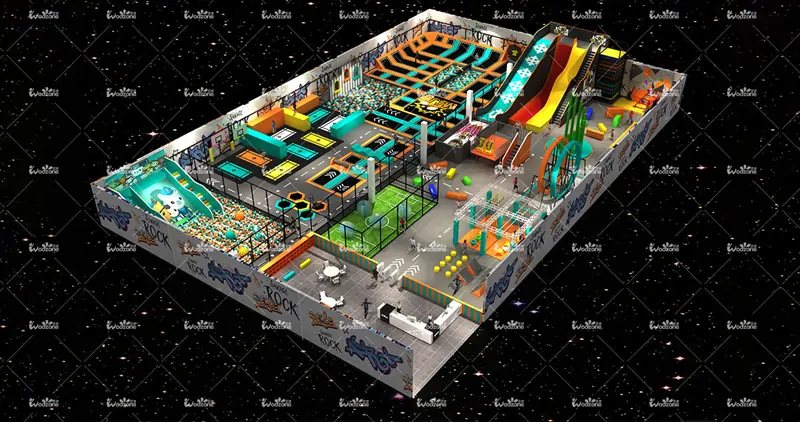
Trampoline parks typically serve a wide age range, from toddlers to adults. The design must separate high‑energy, competitive zones from low‑impact areas to minimise the risk of collisions. A common layout divides the floor into four functional blocks:
-
Free‑jump zone: The largest continuous trampoline area, where visitors can bounce freely. This is often the visual centre of the park.
-
Sports zones: Dodgeball courts, basketball slam‑dunk lanes, and performance trampolines require additional safety perimeters and should be positioned away from the main spectator areas to contain airborne balls.
-
Adventure zones: Foam pits, ninja warrior courses, and climbing walls are high‑excitement but lower‑speed areas that benefit from being located along the perimeter, where the foam or soft landing surfaces can absorb falls.
-
Junior zone: A separated area with smaller trampolines, soft‑play elements, and lower platforms for children under six. This zone must be physically separated from adult areas by fencing or low walls, with a separate entrance and dedicated seating for parents.
The flow between zones should be intuitive. Visitors entering the park should be drawn naturally to the free‑jump area first, with the sports and adventure zones branching off the main circulation path. The junior zone should be visible from the café or viewing area so parents can supervise while seated.
3. Attraction Selection: Matching Equipment to the Market
The choice of attractions depends on the target demographic and the available space. A park aimed at families with young children will emphasise a large foam pit, an interactive projection trampoline, and a soft‑play area. A venue targeting teenagers and young adults will invest in ninja warrior courses, performance trampolines, and dodgeball courts.
Attractions such as the free‑jump area, foam pit, and dodgeball court are considered core components because they appeal to the broadest audience and generate the highest repeat usage. Secondary attractions – including climbing walls, airbags, shuttle ziplines, and doughnut slides – add variety and can differentiate a park from its competitors.
When specifying equipment, the safety standards that apply in the park's region must be confirmed. In Europe, EN 23659 (trampoline parks) and EN 1176 (playground equipment) provide design and testing requirements. In North America, ASTM F2970 covers trampoline park facilities. Equipment from a manufacturer that provides third‑party test reports to these standards reduces the compliance burden on the operator. Many pre‑configured equipment packages for trampoline parks include the core and secondary attractions in standard combinations, which can be adapted to the available footprint.
4. Visitor and Staff Flow
Beyond the play areas, the layout must accommodate the movement of visitors and staff. The reception and check‑in area should provide a clear view of the park but be separated by a controlled entry point. A safety briefing room or area immediately after the entrance is required in many jurisdictions.
Seating for parents and spectators should be positioned along the perimeter with sight lines to the junior zone and free‑jump area. The café or refreshment counter, if included, works best when it overlooks the main activity zones, encouraging longer dwell times.
Staff stations need to be distributed so that every zone is visible to at least one marshal. Elevated observation platforms or raised walkways along the perimeter improve visibility. The layout should allow staff to move quickly between zones without cutting through active jumping areas.
5. Common Design Mistakes to Avoid
-
Placing the foam pit in a corner without an exit path. Jumpers need a clear exit route that does not require walking across active trampolines.
-
Mixing competitive and recreational jumpers in the same zone. Dodgeball and slam‑dunk areas generate lateral movement that can endanger casual jumpers. Physical separation or scheduling is required.
-
Underestimating the storage and maintenance space. Trampoline parks require storage for spare mats, foam cubes, springs, and cleaning equipment. A dedicated maintenance room of at least 15‑20 square metres is advisable, with direct access to the service corridor.
-
Ignoring lighting and acoustics. High‑bay LED lighting should provide uniform illumination without glare on the trampoline surfaces. Sound‑absorbing panels on walls and ceilings reduce the noise level, which can be significant during peak hours.
6. Customising the Design for a Specific Venue
Few buildings are purpose‑built for a trampoline park, so the design usually adapts an existing warehouse, retail space, or sports hall. A professional design team starts with a CAD file of the building shell, including the positions of columns, doors, and utilities. The layout is developed in layers: first, the safety clearances and circulation routes, then the core attractions, and finally the support facilities. You can work with suppliers who offer customised layout design services to build a site‑specific plan from your floor plan.
For operators who want to see completed installations before finalising their design, looking at an Indoor Trampoline Park project portfolio provides a useful reference. Examining how other operators have solved similar space constraints can shorten the design cycle and reduce the risk of an inefficient layout.
A well‑designed trampoline park is efficient to operate, easy to supervise, and inviting to visitors. The time invested in planning the layout, selecting the right attractions, and verifying the space requirements before construction begins pays back every day the park is open. The guide above provides a structured approach to that planning, grounded in the practical constraints that trampoline park operators face in real buildings.




 English
 Español